Explain the Contributions of the Dukes of Burgundy in Late Medieval and Early Renaissance Art
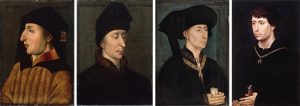
Dukes of Burgundy (from left to right): Philip the Bold, 16th century, oil on panel, 41 × 30 cm (Hospice Comtesse, Lille); After Rogier van der Weyden, John the Fearless, 16th century, oil on panel, 41 × 30 cm (Hospice Comtesse, Lille); Later on Rogier van der Weyden, Philip the Practiced, c. 1450, 29.6 x 21.3 cm (Musée des Beaux-Arts de Dijon); Rogier van der Weyden, Charles the Bold, c. 1454, oil on panel, 49 x 32 cm (Gemäldegalerie, Berlin)
"The unlimited airs of Burgundy! The whole history of that family, from the deeds of knightly blowing, in which the fast-ascent fortunes of the first Philip accept root, to the bitter jealousy of John the Fearless and the black lust for revenge in the years later on his death, through the long summertime of that other magnifico, Philip the Good, to the deranged stubbornness with which the ambitious Charles the Bold met his ruin – is this not a verse form of heroic pride? Burgundy, every bit nighttime with power as with wine…greedy, rich Flanders. These are the same lands in which the splendour of painting, sculpture, and music flower, and where the nearly violent code of revenge ruled and the virtually vicious barbarism spread amongst the aristocracy."
—Johan Huizinga, The Autumn of the Middle Ages, 1919 (1996 english ed.)
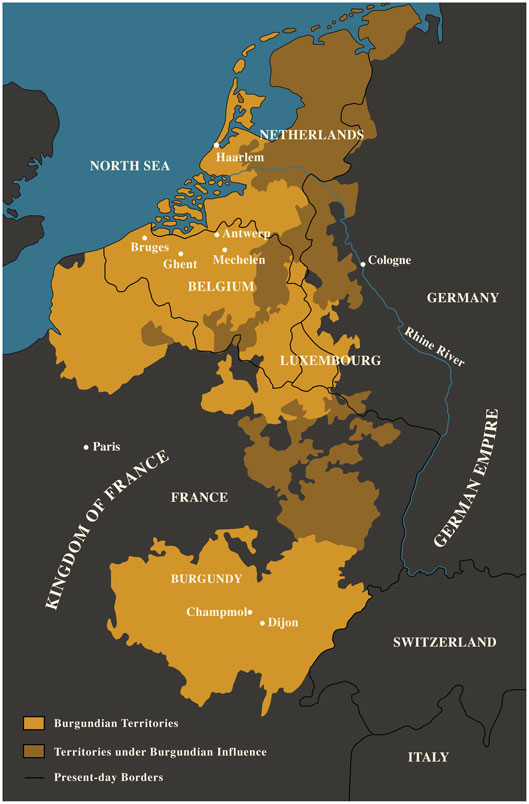
Burgundy and the Burgundian Netherlands: territories inherited past Charles the Assuming in 1467 (map: National Gallery of Art)
This remarkable passage from Johan Huizinga's early twentieth-century archetype The Autumn of the Middle Ages anticipated how the history of Burgundy has been written by many later historians: that is, as a series of successive dukes (Philip the Bold, John the Fearless, Philip the Adept, and Charles the Bold).
The kickoff of these, Philip the Bold, became i of the wealthiest individuals in western Europe after he inherited the county of Flanders from his father-in-law in 1384, adding to his lands in Burgundy. His successors expanded on these holdings to create a territorial ability located between France and the Habsburg Empire.
From the beginning, the dukes of Burgundy aspired to rival kings in their magnificence and authority. Their wealth and access to Flemish craftsmen enabled the dukes to produce 1 of the most visually splendorous court cultures in western Europe, one that in turn influenced purple patronage and anniversary in Espana, France, England, and the Habsburg Empire.
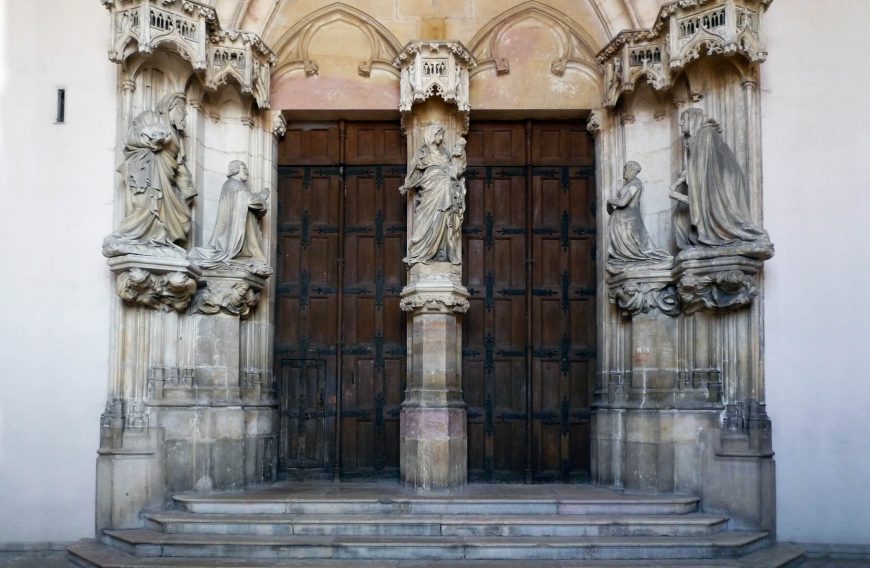
Claus Sluter workshop, Portal of the Charterhouse of Champmol, c. 1385-93 (photo: Dr. Steven Zucker)
Monastery as monument
The first major project undertaken by a Burgundian duke was the construction of a Carthusian monastery outside Dijon, the Charterhouse of Champmol (1383—c. 1410), eventually served as a mausoleum for Philip the Bold and many of his descendants. The monastery was destroyed during the French Revolution and the site is now a psychiatric hospital, but some monuments from it survive, including the tombs of Philip the Bold and John the Fearless.
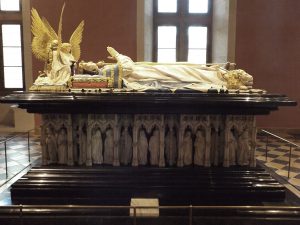
Claus Sluter, Tomb of Philip the Bold, 1390-1406, alabaster, 243 cm loftier (Musée Archéologique, Dijon) (photograph: Dr. Andrew Murray)
Other monuments include the and so-chosen Well of Moses, which sits above a well in the main cloister of the monastery, and which includes life-size statues of Old Testament prophets below a crucifixion scene (that does non survive). The base with the prophets can all the same be visited in its original place, as can the portal to the church building of the Charterhouse, which yet has life-size statues in deep relief of Philip and his wife Margaret praying to the Virgin and Child and supported by donor saints. The Charterhouse of Champmol was intended to secure Philip's retentiveness and prayers for his soul after he died, but it was also a political monument, serving to remind his family and peers of his wealth and power.
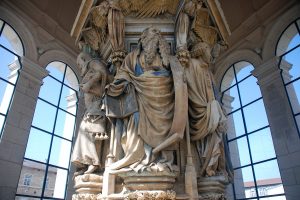
Claus Sluter (with Claus de Werve), Well of Moses, 1395-1405 (prophets 1402-05, painted by Jean Malouel), Asnières stone with gilding and polychromy, slightly less than seven meters high, originally close to 13 meters with cantankerous (photograph: Dr. Steven Zucker)
A turn towards Flanders
During the fifteenth century the main site of ducal patronage moved towards the Burgundian territories in the Low Countries. After the assassination of John the Fearless in the presence of the French king in 1419, the third duke, Philip the Practiced, shifted his attention away from the intrigues of Paris and French republic, focusing instead on consolidating and expanding his territories in kingdom of the netherlands. The near famous artworks made in the court of Philip the Skilful are the paintings of Jan van Eyck, who Philip retained in his services.
Unfortunately, although we know van Eyck made portraits of Philip and his wife, Isabella of Portugal, at that place is no surviving work known to exist commisssioned by Philip. As the art historian Craig Harbison has suggested, van Eyck might accept been most often enlisted by the duke to decorate the ladylike environment, either past painting walls or even designing stages and centerpieces for ladylike ceremonies such equally weddings, funerals, and tournaments. One of the most spectacular types of ceremonies would have been "Joyous Entries": civic processions in which the duke and his entourage were guided through and around a town lined with pageantry, plays, and
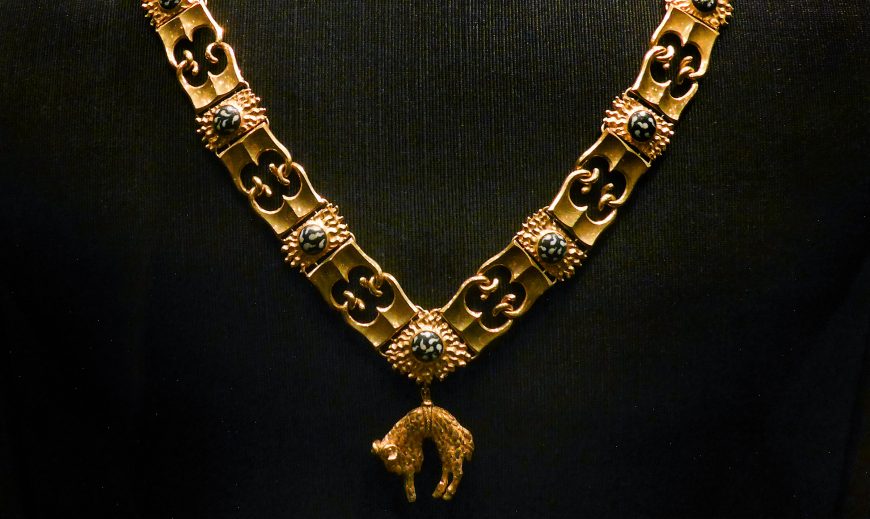
Necklace of the Order of the Golden Fleece, mid-15th century, gold and enamel, 39 cm long (Kunsthistorisches Museum Wien, Weltliche Schatzkammer)
Knights of the Gilt Fleece
Philip the Skillful and Charles the Bold knew their titles (Dukes) were inferior to those of their neighbors (including the Holy Roman Emperor and the King of France), and they both sought crowns from the Holy Roman Emperor. Both also had ambitions to launch crusades confronting the Ottoman Empire. Fifty-fifty though these later ii dukes never went on cause, they oft publicly fashioned themselves every bit defenders of Christendom. These ii rulers therefore favored tapestries and manuscripts that depicted the lives and actions of chivalric heroes, specially those of Alexander the Dandy (who conquered the east) and Saint George (a Christian warrior). In 1454, Philip the Proficient even hosted a one thousand banquet, the famous "Feast of the Pheasant." This spectacle was intended to encourage the members of the chivalric order Philip founded, the Knights of the Gilded Fleece, to vow to back up a crusade. The tables were decorated with statues, and automata (moving statues), and accompanied past music. An elephant (most probably a mechanical i) with an player dressed equally a adult female personifying the church was led before the guests, and the Knights had to brand their oath before a live pheasant decorated with pearls and a gilt necklace (perhaps like that worn by members of the Golden Fleece).
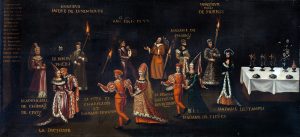
Vow of the Pheasant (Philip the Good and Isabella at the Feast of the Pheasant in Lille in 1454), 16th century, oil on canvas, 39.3 10 85 cm (Rijksmuseum, Amsterdam)
Splendor and ambition
Not everyone in Burgundy shared these chivalric values. The refusal of the Netherlandish towns to fully support and fund Charles's wars played a major office in his downfall and decease at the Boxing of Nancy in 1477. This event marked the showtime of the end for the Burgundian state, but its art and ceremony would remain a strong influence on the Habsburg dynasty that subsequently took control over the Burgundian Netherlands. The towns that had provided the crafts, stages, hosts, and audition for the Burgundian courts would besides go on to develop their own civic visual and ceremonial cultures. The remarkable splendor and influence of the short-lived Burgundian courtroom stemmed from its feverish and oftentimes violent ambition as a wealthy just precarious ability in western Europe.
Additional resources:
Burgundian Netherlands: Private Life, and Burgundian Netherlands: Court Life and Patronage from The Metropolitan Museum of Art'due south Heilbrunn Timeline of Art History
Patronage at the Early Valois Courts (1328–1461) from The Metropolitan Museum of Art's Heilbrunn Timeline of Art History
Art from the Court of Burgundy: The Patronage of Philip the Bold and John the Fearless 1364-1419 , Dijon, 2004.
Karl der Kühne (1433-1477). Kunst, Krieg und Hofkultur, Susan Marti, Gabriele Keck, Till H. Borchert (eds.), Bern, 2008.
Wim Blockmans and Walter Prevenier, The Promised Lands: The Low Countries Under Burgundian Rule, 1369-1530 , Elizabeth Fackelman and Edward Peters (trans.), Philadelphia, 1999 ( This is the shortest and well-nigh easily assessable introduction to the menstruum ).
Wim Blockmans and Walter Prevenier, The Burgundian Netherlands , Cambridge, 1986.
Sherry C. 1000. Lindquist, Agency, Visuality and Gild and the Charterhouse of Champmol , Aldershot and Burlington, 2008
johnsonwituarmay38.blogspot.com
Source: https://smarthistory.org/introduction-to-burgundy/
0 Response to "Explain the Contributions of the Dukes of Burgundy in Late Medieval and Early Renaissance Art"
Post a Comment